

METS PROTOCOL / WHITEPAPER
A closer connection
to growth.
Investment opportunities in private companies, in smaller units.
METS Protocol proposes access to a broad range of private-company investment opportunities through small units. SpaceX, Stripe and OpenAI are representative examples, rather than a fixed list of all companies covered.
CHAPTER 01
Vision and value
Investment opportunities in private companies, in smaller units
METS Protocol is a concept for participating in private-company investment opportunities in small units. It connects an interest in a company's growth with a way to review the underlying assets, units held, costs and conditions for selling or receiving settlement proceeds.
SpaceX, Stripe and OpenAI are representative examples. The intended scope includes these and other private companies; it is not limited to three companies.
Three sources of value
- Start small. Participation is available in smaller units, with the amount specified for each product. Purchase fees are charged separately.
- See what supports your holding. Shares held by a dedicated special purpose vehicle (SPV) are reconciled with the units issued. Monthly reports show asset quantities and costs. Indicative asset values are presented separately from executable market prices.
- Understand the path after purchase. Participants can hold their units, trade with eligible counterparties when conditions match, or receive redemption proceeds after the underlying shares have been sold and settlement is complete.
Who can participate
Participants must complete identity verification and satisfy the conditions of each product. METS ownership is not required for general participation. Participants who choose to use METS can access priority application tiers and trading fee discounts under the conditions described later in this paper.
Products are selected company by company across a wider universe of private companies. The available companies and product conditions will be disclosed for each opportunity.
CHAPTER 02
Company examples and asset acquisition
Representative examples
| Company example | Sector | Illustrative asset-token symbol |
|---|---|---|
| SpaceX | Space and transportation | mSPCX |
| Stripe | Payments and financial infrastructure | mSTRIP |
| OpenAI | Artificial intelligence | mOAI |
These names illustrate the intended investment universe. They do not define a fixed company count. The companies actually covered, asset quantities and number of units issued will be specified for each product.
Participation is available in smaller units. The participation amount and issuance conditions are specified for each product, based on its structure and acquired assets.
Holding assets through a dedicated SPV
A company-specific SPV holds the relevant shares. Product information discloses the share class, quantity, acquisition cost, settlement conditions and restrictions on selling the shares.
Funds used to acquire product assets are separated from platform operating funds. Assets and funds belonging to different products or acquisitions are not combined without distinguishing their respective rights and conditions.
Acquisition sequence
- Identify a candidate company and an available acquisition opportunity.
- Review the asset and participant eligibility requirements.
- Confirm the quantity, acquisition price and allocation conditions.
- Issue the corresponding units after acquisition and allocation are confirmed.
If applications or funds are accepted before acquisition, the offer conditions must explain what happens if the acquisition fails. Refund conditions, including any disclosed deduction of direct costs, are presented before participation.
CHAPTER 03
Two tokens and their rights
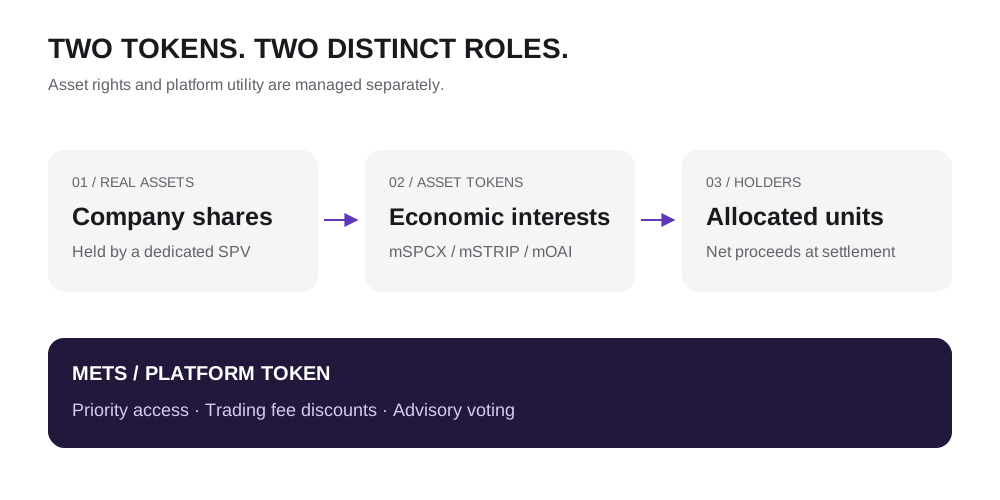
Separate asset rights from platform utility
| Item | Asset tokens | METS |
|---|---|---|
| Purpose | Record economic interests in an individual product | Priority applications, fee discounts and advisory voting |
| Examples | mSPCX, mSTRIP, mOAI | One common platform token |
| Supply | Units corresponding to the product's assets | Fixed total of 1,000,000,000 |
| What holders receive | A share of net proceeds at settlement, under product terms | Platform benefits and advisory participation |
| Illustrative initial price | Initial participation amount specified for each product; subsequent trades at an agreed price | $0.05 in the initial sale; subsequent price determined by the market |
What one asset-token unit means
If an illustrative product issues 50,000 mSPCX units, one unit represents 1/50,000 of that product's applicable net assets and settlement proceeds. It does not mean one SpaceX share or ownership of 1/50,000 of SpaceX itself.
Units within the same product have equal economic rights under that product's terms. The SPV holds the actual shares and exercises the shareholder voting rights. Direct exercise of those shareholder votes by asset-token holders is not planned. The specific rights, claims and procedures are defined in the applicable contracts and product terms.
What METS provides
Locking METS for 90 days enables the relevant priority tier and trading fee discounts. METS can also be used to communicate preferences through advisory votes.
METS itself does not confer ownership of an SPV's assets or a right to redeem those assets. Participation in a particular company's product requires that product's asset token.
CHAPTER 04
Participation and redemption
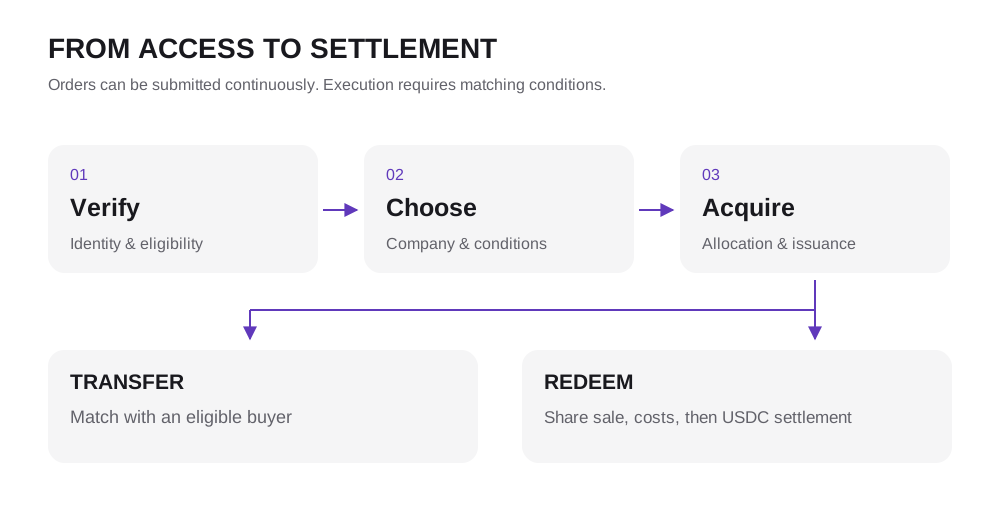
1. Verify identity and eligibility
Complete identity verification, register a wallet and confirm eligibility for the selected product.
2. Choose a product
Review the company, underlying assets, number of units, fees, participation conditions and restrictions on trading and redemption.
3. Apply and acquire units
Initial applications are made in smaller units. The participation amount, application unit and maximum are specified for each product. The initial purchase fee is an additional 2%. Payment is planned in USDC.
Units are issued following asset acquisition and allocation. Unallocated amounts are returned under the disclosed conditions.
4. Review holdings and orders
Participants can review their allocated units, asset reports, orders and indicative values. The interface distinguishes units held, units offered for sale, completed trades, applicable fees and settlement status.
Orders are intended to be accepted continuously. Execution requires an eligible counterparty and matching price and quantity. An unmatched order is not a promise of immediate cash access.
5. Sale of underlying shares and redemption
An IPO, M&A transaction or other exit may create an opportunity for the SPV to sell shares. The SPV sells only when the applicable restrictions permit it. Expenses and taxes are settled, and distributable proceeds are converted into USDC as required.
Redemption follows completion of the asset sale and settlement. An IPO does not trigger immediate redemption by itself.
The operator discloses the eligible units, net proceeds per unit, procedure, expected timing and how to claim. Redeemed tokens are burned after settlement. Rounding and unclaimed amounts are handled under the product's terms.
CHAPTER 05
METS utility and priority tiers
Participation tiers
| Tier | 90-day METS lock | Application access | Secondary trading fee discount |
|---|---|---|---|
| Standard | None required | General allocation | None |
| Silver | 1,000 METS | General and Silver priority allocations | 25% |
| Gold | 10,000 METS | General and Gold priority allocations | 50% |
Locking METS is a condition for platform benefits. It does not generate a fixed interest payment.
Allocation of an offer
The illustrative allocation is 60% for general applications, 20% for Silver and 20% for Gold. Priority applications open 48 hours before general applications. Unused priority capacity moves to the general allocation.
Silver and Gold participants may also apply through the general allocation. The combined limit remains $10,000 per person per deal.
If an allocation is oversubscribed, units are allocated proportionally. Allocations are rounded to whole units; any remaining units are assigned by a draw. An allocation below one unit does not result in a purchase. Unallocated funds are returned.
Locking and withdrawal
The lock lasts 90 days and does not renew automatically. After the period ends, withdrawal follows the specified process. Each new priority participation requires a new 90-day lock. Fee discounts apply while the relevant lock is active.
Initial-sale tokens that have not yet been unlocked cannot be used to qualify for a tier.
Community participation
METS holders can express interest in candidate companies and preferences for product improvements through advisory votes.
Community rewards, if offered, are funded from a separately defined ecosystem budget with activity-specific conditions. They are not an automatic dividend or a promised annual yield.
CHAPTER 06
Fees and calculation examples
Fee schedule
| Item | Illustrative fee | How it is applied |
|---|---|---|
| Initial purchase | 2% | Added to the purchase principal |
| Secondary purchase | 0.5% | Charged to the buyer |
| Secondary sale | 0.5% | Charged to the seller |
| Asset management | 1% per year | 0.25% of the quarter-end indicative net asset value before this charge, deducted quarterly from the product |
| Redemption | No performance fee | Actual expenses and unsettled costs are reconciled |
| Network | Additional | Based on the relevant network costs |
Tier discounts apply only to secondary trading fees.
How initial purchase costs work
Principal is calculated using the participation amount and application units specified for each product. The total, including the initial purchase fee, is shown before purchase. The fee is 2% of the purchase amount and does not purchase additional units.
Secondary trade example
For an illustrative trade value of $1,200:
| Case | Fee | Total paid or received |
|---|---|---|
| Standard buyer | $6 | Pays $1,206 |
| Standard seller | $6 | Receives $1,194 |
| Gold seller, 50% fee discount | $3 | Receives $1,197 |
The $1,200 figure is a hypothetical execution price, not a price forecast. Network costs are excluded from these examples.
Redemption example
Suppose the underlying shares are sold for $6,000,000, with $300,000 in expenses and taxes, and the product has 50,000 eligible units.
- Net distributable proceeds: $6,000,000 − $300,000 = $5,700,000.
- Proceeds per unit: $5,700,000 ÷ 50,000 = $114.
- Proceeds for ten units: $1,140.
The $300,000 expense assumption is not based on a tax rate for any particular jurisdiction. Actual proceeds depend on the sale and settlement. Participants may receive less than their original principal.
CHAPTER 07
Issuance and allocation
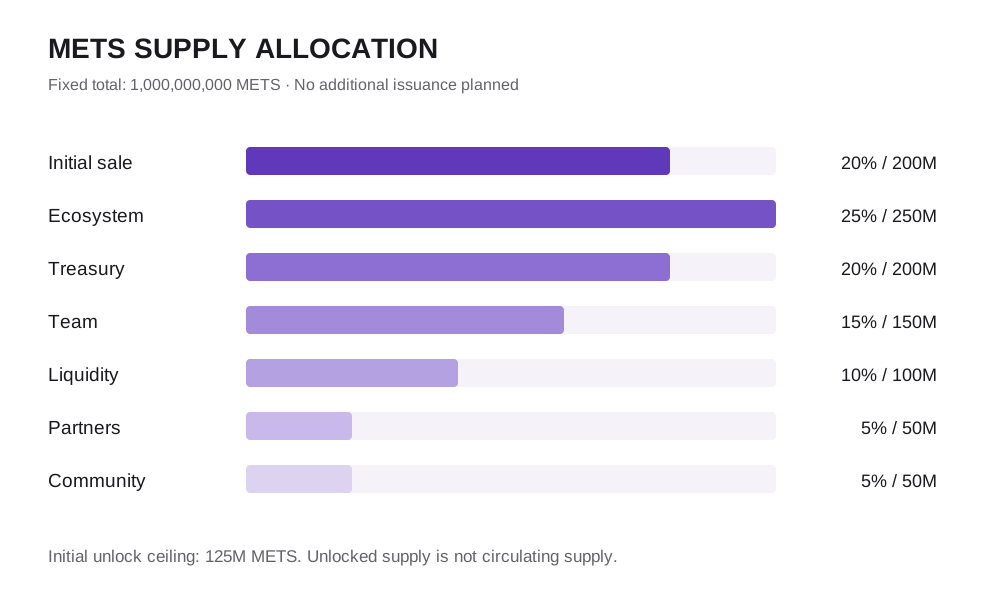
Fixed total supply
The proposed total is 1,000,000,000 METS, with no additional issuance planned. The initial sale allocation is 200,000,000 METS at an illustrative price of $0.05 each.
Multiplying the total supply by that initial price gives a $50,000,000 reference figure. This is not the amount raised and is not the value of assets backing METS.
Supply allocation
| Allocation | Share | METS |
|---|---|---|
| Initial sale | 20% | 200,000,000 |
| Ecosystem | 25% | 250,000,000 |
| Treasury | 20% | 200,000,000 |
| Team | 15% | 150,000,000 |
| Liquidity | 10% | 100,000,000 |
| Partners | 5% | 50,000,000 |
| Community | 5% | 50,000,000 |
| Total | 100% | 1,000,000,000 |
Unlocking schedule
| Allocation | Proposed schedule |
|---|---|
| Initial sale | 10% at issuance; the remaining 90% released evenly over 18 months starting the following month |
| Treasury | 12-month cliff, followed by an even release over 36 months |
| Team | 12-month cliff, followed by an even release over 36 months |
| Partners | 12-month cliff, followed by an even release over 24 months |
| Ecosystem | Over 60 months, with a maximum of 50,000,000 METS per year; unused amounts remain held |
| Community | 10% at issuance; remaining 90% distributed for eligible activities over 24 months |
| Liquidity | Released at issuance, restricted to its stated purpose, with usage reported |
The initial unlock ceiling is 125,000,000 METS: 20,000,000 from the initial sale, 100,000,000 for liquidity and 5,000,000 for community activities. Unlocked supply is not necessarily circulating supply.
Buyback and burn
The proposal allocates 20% of actual secondary trading fees, after discounts and refunds, to quarterly METS purchases and burns. Reports disclose the amount spent, tokens purchased and burned, and relevant transactions.
This mechanism does not set or promise a token price or investment return.
CHAPTER 08
Business model
Sources of operating revenue
The platform's proposed revenue sources are initial purchase fees, secondary trading fees and asset management fees, as described in Chapter 6.
- Initial purchase fees arise when an initial purchase takes place. They are not recurring fees charged repeatedly on the same holding.
- Secondary trading fees arise from executed trades, rather than from submitted but unmatched orders.
- Asset management fees relate to the assets being managed and the disclosed calculation method.
Separate asset funds from operating funds
Funds used to acquire assets for a product are managed separately from the platform's operating funds. Product reporting distinguishes the underlying assets, units issued and fees charged.
Develop the service in stages
Each phase expands the service's functions and company-specific products. The operator reviews ongoing usage, completed trades, operating costs and support workload, and adjusts the service's scope and operating approach accordingly.
CHAPTER 09
Asset management and decision-making
Initial operating structure
The illustrative initial team has seven people: one project lead, two people in origination, two in product and technology, one in asset operations and one in participant support. Custody, contractual work and reconciliation may use external providers as required.
| Function | Main responsibility |
|---|---|
| Project lead | Overall decisions, execution priorities and accountability |
| Origination | Candidate companies, acquisition opportunities and transaction conditions |
| Product and technology | Platform development, wallet and token functions, access controls and operational tooling |
| Asset operations | Asset records, reconciliation of shares and units, reporting and settlement administration |
| Participant support | Applications, identity-verification support, inquiries and procedural guidance |
| External specialists and providers | Assigned custody, contract and record-verification functions |
Reporting and reconciliation
Monthly reports present asset quantities, issued units, costs, indicative net asset values and material changes. Records are reconciled and checked on a quarterly basis.
Verifying an asset quantity is different from determining its value. An indicative valuation may not be a price at which the asset can be sold. Reports identify the source and date of each valuation.
Advisory participation and operating decisions
METS votes communicate interest in candidate companies and preferences for features. The operator remains responsible for product selection, offer conditions, budgets and execution decisions.
A popular candidate may not be available for acquisition. In that case, the operator explains the constraints and decision. Advisory voting does not transfer the operator's responsibilities to token holders.
CHAPTER 10
Technical structure and disclosure
Connect asset operations with digital records
Share acquisition, custody and sale take place through the SPV and related off-chain processes. Digital records support the number of units, transfers, locks and redemption procedures.
| Layer | Main scope |
|---|---|
| Real assets | Acquisition contracts, asset records, sale proceeds, expenses and taxes |
| Operating systems | Identity checks, product terms, orders, reporting and support |
| On-chain records | Balances, transfers, locks, redemption and token burns |
| Participant interface | Product comparison, holdings, orders, settlement status and documents |
Identity documents and complete acquisition contracts are not placed on a public blockchain. They are stored with appropriate access permissions.
Candidate token specifications
ERC-20 is a candidate reference for balances, transfers and allowances.
ERC-3643 is a candidate reference for identity registries, transfer checks, pause and freeze controls, and recovery interfaces.
The chain, contracts, administrative controls and recovery procedures remain to be selected. This paper does not claim that a contract address or completed audit already exists.
Asset evidence and disclosure
The original concept's “Proof of Equity” is interpreted here as monthly asset records and quarterly verification. Oracle-based connections can be considered in a later phase.
Reported figures identify their date, method and scope. A blockchain record alone does not prove the prior acquisition or valuation of the underlying shares.
CHAPTER 11
Roadmap
Stage 01 — Establish participation
Prepare the first product, its terms and asset evidence, and the identity-verification, purchase and holdings functions.
The completion gate is an end-to-end reconciliation of acquired assets and issued units, supported by issuance records and asset reports.
Stage 02 — Expand company-level choice
Expand to additional company-specific products, enhance holdings management, enable participant-to-participant trading and introduce METS tiers.
The completion gate is verification of segregated funds, settled quantities and fees, with eligibility and transaction conditions visible to participants.
Stage 03 — Support ongoing participation
Broaden the product range and strengthen recurring reports and operations for asset sales and redemption. Monitor asset volumes, continued usage, completed trades, costs and support response times.
Report progress by actual status
Progress reports distinguish acquired assets, transactions in contract preparation and opportunities under consideration. If a milestone is delayed or the sequence changes, the operator explains the reason, impact and next steps.
CHAPTER 12
Uncertainties and responses
Situations that can affect participation
| Situation | Potential impact | Proposed response |
|---|---|---|
| An acquisition does not complete | The intended product cannot be issued | Apply the disclosed conditional refund procedure |
| No matching trading counterparty | A participant cannot sell when desired | Show order status and explain that unmatched orders do not guarantee liquidity |
| An IPO or share sale is delayed | Holdings remain outstanding for longer | Report the relevant restrictions and revised outlook |
| Asset value falls | Redemption proceeds may be below principal | Explain valuation assumptions and avoid promising principal protection |
| Asset records and issued units do not reconcile | Reported entitlements may be inaccurate | Pause affected procedures, reconcile the records and notify participants |
| An outage or unauthorized access occurs | Access or transactions may be interrupted | Establish the affected scope, recovery steps and conditions for resuming operations |
| USDC use or conversion is disrupted | Payments or settlement may be delayed | Monitor inflows and outflows and communicate the operational impact |
| Operating funds are insufficient | New products or development may be delayed | Review service scope, expenses and additional funding needs |
Distinguish the two token exposures
Changes in the market price of METS affect the cost of qualifying for priority benefits. Asset-token prices and settlement proceeds depend on the specific product and its underlying assets.
Communicate changes
Notices identify the affected product, effective date, procedure and any action required from participants. Material changes are recorded in a revision history.
CHAPTER 13
Glossary and references
Glossary
| Term | Meaning in this paper |
|---|---|
| METS Protocol | Meta Equity Trading System; the name of the overall project |
| METS | The common token for priority access, discounts and advisory votes |
| Asset token | A token recording units of economic rights in a company-specific product |
| SPV | A special purpose vehicle established to hold and manage specified assets |
| RWA | Real World Asset; a term used in the context of real-world assets |
| Pre-IPO | The period before a company's shares are publicly listed |
| KYC | Identity verification, considered together with product eligibility checks in this paper |
| USDC | The digital currency proposed for payments and redemption |
| Lock | A restriction on transferring or withdrawing tokens for a specified period |
| Unlock | The scheduled removal of transfer restrictions, including restrictions on sale allocations |
| Indicative net asset value | A reference value calculated from asset valuations and costs; distinct from an execution price |
| Redemption | The process of receiving proceeds in proportion to units after a product is settled |
| Burn | The removal of the relevant tokens from supply |
Calculation assumptions
Amounts are based on USD. Where a JPY illustration is used, it assumes a fixed conversion of ¥150 per dollar and does not represent a current exchange rate.
Fee examples exclude network costs. The $300,000 expense assumption in the redemption example is not based on a particular jurisdiction's tax rate.
References
- ERC-20: Token Standard: a candidate technical reference for Chapter 10.
- ERC-3643: T-REX: a reference for transfer conditions and management interfaces in Chapter 10.
Specification reference date: September 16, 2026. Referencing these standards does not establish that METS has implemented them or that its operations have been assessed for compliance.